UT-Arlington Baseball To Retire Trey Hillman’s Jersey Number

Ceremony Set For May 8

ARLINGTON, Texas – The UT Arlington baseball program will retire former Maverick and current Kansas City Royals manager Trey Hillman’s #1 jersey number prior to the first pitch of UT Arlington’s Saturday, May 8, game against Stephen F. Austin at 2 p.m. at Clay Gould Ballpark.

Hillman’s (1982-85) #1 jersey will join former head coach Butch McBroom (#30) and the late former player, assistant coach and head coach Clay Gould (#8) as the only jersey numbers retired in UT Arlington baseball history.

Hillman, the only three-time All-Southland Conference selection in UTA history, will be in attendance for the ceremony as the Kansas City Royals are schedule to take on the Texas Rangers at the Ballpark in Arlington May 6-9.

“It is a great honor, especially to join the only other two people who have had their numbers retired,” Hillman said. “I have great memories playing at UTA and Arlington will always be my hometown. I’m looking forward to coming back and being able to share that day with everyone at UT Arlington.”

Trey Hillman

Just 16 months ago, Hillman returned to his alma mater when he was named a Distinguished Alumni at the 43rd Annual UT Arlington Distinguished Alumni Gala. After a four-year career with the Mavericks, Hillman signed a free agent contract with the Cleveland Indians. Hillman later returned to UT Arlington where he earned a bachelor’s degree in exercise science and sport studies in 1991.

One of the top players in UT Arlington history, Hillman became the first Maverick baseball player inducted into the UT Arlington Athletic Hall of Honor in 1992. Hillman’s .442 batting average in 1985 – which led the Southland Conference – remains the top single-season batting average in UTA history and is the second best average in Southland Conference history.

After completing his professional playing career in the Cleveland Indians’ minor league system in 1987, Hillman spent one season scouting with the Indians before becoming the youngest minor league manager at that time with the New York Yankees Class-A club in the Carolina League. He then spent 12 years managing in the Yankees minor league system from 1990-2001.

After one season as the director of player development with the Texas Rangers, Hillman accepted a managerial position with the Hokkaido Nippon-Ham Fighters in Japan. During five seasons in Japan, the Nippon-Ham Fighters made three playoff appearances (2004, 2006, 2007), which includes winning the 2006 Japan Series championship and the 2006 Asian Championship. It was the first title for the Nippon-Ham Fighters franchise since 1962.

Hillman became the 15th manager in the history of the Royals on Oct. 19, 2007, and has followed by leading the Royals to 140 wins in two seasons, which is the most wins during the first two seasons by a Royals manager since Bob Boone won 145 games in 1995-96.

Two other familiar faces to the UTA program will be on hand with Hillman as his third base coach, Dave Owen (1977-79), and bullpen coach, Steve Foster (1987-88), will also return to UT Arlington for the ceremony.

Owen became the first former Maverick to make it to the big leagues with the Chicago Cubs in 1983 and Foster pitched three seasons with the Cincinnati Reds from 1991-1993. Owen will start his third season on the Royals coaching staff this year while Foster is joining the Royals after spending the past three seasons as the bullpen coach for the Florida Marlins.

(Release)

Szczur Carries Villanova To FCS Football Championship

Two Sport Star Shines In Title Game Win Over Montana

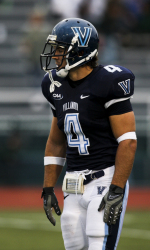
Chattanooga, TN– Former Oakland Raider Howie Long may be Villanova’s most famous football player, but it would be hard to argue against Matt Szczur as Villanova’s most important football player.  Szczur scored two touchdowns to lead the Wildcats to a 23-21 win over Montana in Friday’s FCS Division I National Championship game.

Szczur totaled 227 yards from scrimmage to carry the third-seeded Wildcats (14-1) past the top-seeded and formerly unbeaten Grizzlies (14-1).  The junior receiver ran for a career best 159 yards on 14 carries (most from the Wildcat

Matt Szczur scored 15 TDs in 2009

Matt Szczur scored 15 TDs in 2009

formation) and had four catches for 68 yards.  He scored Villanova’s first touchdown of the night on a 5-yard run with 3:34 to go before halftime and scored their last TD to give his team a 23-14 lead with 11:04 remaining in the game.

“To be honest, I didn’t think I was going to break as much as I did,” Szczur said after the game.  ” The offensive line came out, and I hada great second half. They gave me an opportunity to make the big plays as well as Coach [Andy] Talley and Coach [Sam] Venuto giving me the opportunity to run the ball.”

FCS Title Game Box Score (PDF)

Szczur was one of the most versatile players in the country all season.  While the 5′10 junior is listed as a wide receiver, he has packed several sections of the Villanova stat book:

Rushing:  108 carries for 813 yards and a team-high 10 TDs

Receiving:  51 catches for 610 yards and 4 touchdowns

Passing: 4-for-4 for 22 yards and 2 TDs

Kick Returns:  30 for 816 yards (27.2) and an 87-yard touchdown

He was named the 2009 Colonial Athletic Association’s Offensive and Special Teams Player of the Year, but his versatility reaches beyond the football field.  Szczur is also a member of the baseball team, and it’s only fitting that he’s

Szczur is MLB draft eligible in 2010

Szczur is MLB draft eligible in 2010

listed as both a catcher and outfielder on Joe Godri’s Wildcat roster.

Szczur led VU with a .346 average last spring after missing his freshman baseball season due to injury.  He’ll take a short break and then begin training for the Feb. 19 baseball season-opener at Norfolk State.  The Erma, N.J. native still has a season of football eligibility remaining, but he was caught off guard Friday night when asked about his plans for the future.

“That’s a hard question to answer. You put me in a bind right now,”  Szczur said.  ” We’re going to see how my baseball
season turns out. After baseball season, I’ll probably end up entering the draft, but I love these guys.
[Chris] Whitney, Terry [Thomas], all these guys are my best friends. We started as freshman, and we
wanted to do something. We accomplished it, so I don’t want to leave those guys. It’s a hard decision to
make, but it’s a good decision to make.”

He was drafted in the 38th round of the MLB draft by the L.A. Dodgers out of high school.  If he goes in the June draft it is still possible that Szczur could play in the minor leagues next summer and then return to the gridirion with the Villanova football team next fall.   That’s something current Chicago Cubs pitcher Jeff Samardzija did in 2006 when he was playing both baseball and football at Notre Dame.

Now if Szczur could only pass his hair style along to Howie Long.

Note:  Szczur and others have been included in the exclusive Collegebaseball360.com Two Sport Reports throughout the fall.  We’ll have a new installment coming soon!

Golden Tate By The Numbers

A Look At Some Of The Stats Tate Has Put Up On The Gridirion & Diamond At Notre Dame

By Collegebaseball360.com Editor Sean Stires

So, Golden Tate is going to the NFL.  It comes as no surprise to most people, but I for one thought he might give

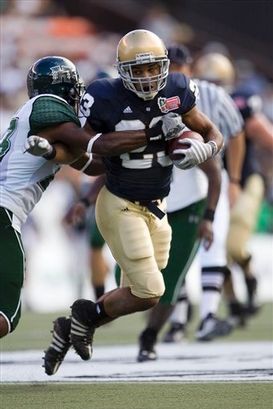
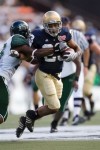
Golden Tate declared for the NFL draft on Monday (AP Photo)

Golden Tate declared for the NFL draft on Monday (AP Photo)

college baseball one last go round.  After all, Tate was actually recruited by the Irish baseball team before ND football recruiting coordinator Rob Ianello got him on campus for a visit.

Tate also had the model of Jeff Samardzija, another former Irish two sport guy, to look at.  Samardzija was the guest speaker at the Notre Dame baseball Opening Night Dinner before last season and he prophetically told Tate “You might break my records, but you’ll never look this good.”

Like Tate, Samardzija didn’t burst on the national stage until after a monster junior season on the football field.  MLB scouts then flocked to Irish baseball games all spring in 2006, and Samardzija capitalized when he was drafted by the Chicago Cubs in the first round, played minor league baseball that summer, and then caught more passes from Brady Quinn that fall.

Samardzija has something Tate doesn’t though (besides his trademark shaggy hair):  a 6′5 frame with an upper 90s fastball.  Tate is just 5′11, albeit with blazing speed, but he was still considered a work in progress on the baseball field.

With that said, Tate did play two seasons of college baseball, and he rewrote the Irish receiving record book in just three seasons.

Here’s a By The Numbers look at Tate’s two sport career at Notre Dame:

1,496…receving yards by Tate this season-a new Notre Dame school record

1,211…total receiving yards in his first two seasons combined

15…touchdown catches in 2009 for Charlie Weis and the football team

16…career stolen bases with the Irish baseball team

93…football receptions in 2009-also a new school record

92…total bases on the diamond in 2009

(ND Photo)

(ND Photo)

8…straight games with a touchdown catch in 2009-a school record tied with Samardzija

8…doubles for the baseball team in 2009

2…games of 200-plus receiving yards this season-including a school record 244 vs. Washington

222…career at-bats as a baseball player

.329…batting average in 2009

63…career starts for baseball head coach Dave Schrage

64…combined receptions as a freshman and sophomore in 2007 & 2008

9…games this season with 100-plus receiving yards – another single-season school record

7…sacrifice bunts in 2009 – the second-most by an Irish player

1,915…all-purpose yards during the 2009 football season

1…Irish player with more all-purpose yards in a season – Tim Brown with 1,937 in 1986

1…career home run by Tate – a late inning longball that helped his team win a crucial late April series at Louisville

22…career base on balls drawn by Tate

23…his jersey number with the football team

32…Tate’s baseball number

21…RBIs in 2009

11…straight games with either a receiving, rushing or punt return TD in 2009

.813…OPS (on-base plus slugging %) in 2009

0…other college baseball players who are a 2009 Biletnikoff Award finalist

(Tate is one of more than 35 players who have been featured in the exclusive Collegebaseball360.com Two Sport Reports.)

Texas Baseball To Retire Keith Moreland’s Jersey Number

Longhorns legend will have his No. 3 retired during the 2010 baseball season

AUSTIN, Texas — Former Longhorn legend Keith Moreland will have his jersey number retired, the UT Intercollegiate Athletics Council for Men announced on Thursday. His No. 3 will be retired prior to a game during the 2010 season.

“I am humbled to have my number retired by The University of Texas,” Moreland said. “To have my number hang along with some of the most elite players to ever play college baseball is such an honor.”

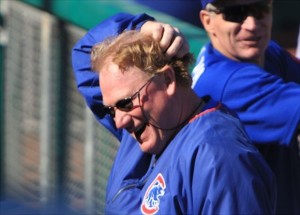
Longhorn great and former big leaguer Keith Moreland (shown at a Cubs event)

Longhorn great and former big leaguer Keith Moreland (shown at a Cubs event)

Moreland, a three-time first-team All-America on the Forty Acres, led the Longhorns to a College World Series in each of his three seasons (1973-75) and was one of the key components of Texas’ 1975 College World Series championship team. He was primarily a third baseman at Texas.

The Carrollton, Texas, native ranks third in the Texas annals with a career .388 batting average. Moreland also ranks second in hits (274), seventh in RBI (183) and eighth in doubles (53). During his three-year career, the Horns amassed a 160-21 record, including a 58-8 mark in Southwest Conference action and three league titles.

As a freshman, Moreland hit .349 with 43 runs, 11 doubles, three triples, five home runs, 42 RBI and five stolen bases. Texas finished 50-7 overall, 15-3 in the SWC and tied for third at the CWS.

During his sophomore campaign, Moreland batted .399 with 69 runs, 25 doubles, three triples, six home runs, 72 RBI and 14 stolen bases. The Horns finished 54-8 overall, 20-4 in the SWC and placed fourth at the CWS.

As a junior, Moreland hit .410 with 57 runs, 17 doubles, two triples, four home runs, 69 RBI and 11 stolen bases and served as co-captain for the 56-6 national championship team.

He was named to the College World Series All-Decade Team for the 1970s and his 23 career hits at the College World Series ranks second all-time in the history of the tournament.

Moreland also played football on the Forty Acres, earning a gridiron letter in 1973.

Moreland went on to a 12-year Major League Baseball career as a catcher, third baseman and outfielder. He played four seasons with the Philadelphia Phillies and was a member of their 1980 World Series championship team. He spent six seasons with the Chicago Cubs and helped them win the 1984 National League Eastern Division championship, the first title of any kind for the Cubs since 1945. He had stops with the San Diego Padres, Detroit Tigers and Baltimore Orioles.

His best season came in 1985 with the Cubs, when he ranked fourth in the National League in RBI (106) and seventh in batting average (.307). Moreland hit .279 with 1,279 hits, 214 doubles, 121 home runs and 674 RBI for his career. He batted .364 in the post-season, including two doubles, one home run and seven RBI in 14 games.

Since retiring from baseball in 1989, Moreland has remained in the athletics industry. Most notably, Longhorns fans may recognize Moreland as the color analyst for the radio broadcasts of Texas Football and Baseball games.

Moreland received his bachelor’s degree in kinesiology from UT in 1991.

“One thing that was really special to me was to come back and get my degree from The University of Texas. That was something I wanted to do when I started school,” Moreland said. “To come back and get my degree was probably something as special as there is compared to anything I’ve been involved in.”

Moreland and Kirk Dressendorfer were both inducted into the College Baseball Hall of Fame last July, giving Texas a total of seven inductees since the Hall opened in 2006. Moreland was inducted in the Longhorn Hall of Honor in 1985.

(Release)

Golden Tate Podcast Interview

Audio clip: Adobe Flash Player (version 9 or above) is required to play this audio clip. Download the latest version here. You also need to have JavaScript enabled in your browser.

TateTate has burst onto the national scene this season as a college football star, but he’s a college baseball player at Notre Dame as well.  The Fighting Irish wide receiver/outfielder has become a Biletnikoff Award finalist and househould name on the gridiron this season while breaking most of the Notre Dame school records originally set by another Irish two-sport phenom, current Chicago Cubs pitcher Jeff Samardzija.

This interview with CB360.com Editor Sean Stires was recorded during the spring and it’s still relevent today.  Tate talks about his development as a college baseball player, balancing two sportstatebaseball at the college level, how playing football helps him on the diamond and vice versa, and his first and still only career home run against Louisville.

5′11 – 195 – Jr. – Hendersonville, TN                   Head Baseball Coach:  Dave Schrage

Tate and other two-sport players have been featured in our Two Sport Reports throughout the fall.

Charlie Weis Talks Gerhart & Tate

Two Top Two-Sport Stars Go Head-to-Head Saturday

Stanford’s Toby Gerhart and Notre Dame’s Golden Tate have three things in common:  1. They both play college football 2. They are both college baseball outfielders and 3. Irish football coach Charlie Weis talked about both of them at his weekly press conference Tuesday afternoon.  (They might actually have more than that in common, but that’s the nutshell version.)

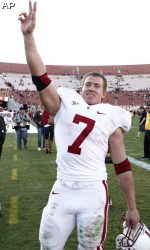
Toby Gerhart

Toby Gerhart

Gerhart is a 6′1, 235 lb. senior who has rolled through Pac 10 defenders like a bowling ball through Weebles this season to the tune of 1,531 yards (2nd in the nation) and 23 nation-leading touchdowns.  He is one of three finalists for the Doak Walker Award, which is given to the nation’s top college running back each season.

At 5′11 and 195 pounds Tate is the lightning to Gerhart’s thunder.  His blazing speed has helped him reel-in 83 receptions for 1,295 yards (both ND school records) with 12 touchdown grabs.  Tate has also rushed for two touchdowns, and returned a punt 87 yards for another score.  His efforts rank him fourth nationally in receiving yards and have made him one of three finalists for the Biletnikoff Award, which is bestowed annually upon the nation’s top college receiver.

Gerhart has now exhausted his football eligibility, but he has one season of eligibility left if he decides to play for Mark Marquess and the Cardinal baseball team next spring.  (That could be tough with the NFL draft in April.)  Gerhart has made 105 baseball starts in his first three seasons while helping Stanford to the 2008 College World Series.

Tate has a few more options remaining.  As a junior on the Irish football team he could still return for a last bit of

Golden Tate

Golden Tate

gridiron refining next fall.  He also has two years of baseball eligibility left, so he could potentially patrol the outfield for Dave Schrage for two more seasons.  He could also go the route of another former Irish two-sport star, Jeff Samardzija, who is now a pitcher for the Chicago Cubs.  Samardzija played minor league baseball after his junior baeball season, and then returned for his senior football campaign to break more records & catch more passes thrown by current Cleveland Brown QB Brady Quinn.  (Tate has already broken Shark’s single-season yardage record and needs just 88 yards to break his career mark of 2,593.)

But here’s the best part:  We get to see both Gerhart and Tate in action on the same field while we’re gorging on leftovers this weekend when Notre Dame visits Stanford this Saturday night in the regular season finale for both teams.

*CLICK HERE to read the Collegebasell360.com Two Sport Reports which have featured Gerhart, Tate & other two sport athletes throughout the fall.)

Following is what Weis had to say about each of them on Tuesday:

On Toby Gerhart

Q.  Their running game, what do you need to do to slow that down?  What do they do that makes them so successful?

WEIS:  Well, I mean, I could talk about their offensive line, I could talk about their tight ends and I could talk about their scheme and their mentality, but

That No. 7 (Gerhart), the guy with the ball in his hands, you know, he’s special.  He’s a hard north‑south runner.  Not that he can’t bounce it outside, but you have to gang‑tackle him, and we’ve had a few problems with tackling now, and I think that if you don’t gang‑tackle him, he gets a lot of hidden yardage because you don’t get 139 yards a game by just being running in open field all the time and just by scheme.  I mean, this kid is a heck of a runner.  I have a lot of respect for him.

Q.  Where does Gerhart rank in terms of the skill position players you guys have faced this year?

WEIS:  Well, I think that, for example, if you’re going into the draft, let’s take him ‑‑ with this guy, you’re going into the draft, he’ll be one of the first guys taken, because one of those guys who wants a guy, a dependable, every‑down runner they can just hand the ball to 25, 30 times a game, there aren’t very many of them that are that type of size that are that type of durable that have proven track records.  He obviously has a proven track record.  So he’s right up there with the best of them.

There’s guys that we play that are faster than him, but I don’t know if there’s any more grounded than this guy.

Q.  I know you get this kind of question a lot.  Who does he remind you of?  Is there anyone?

WEIS:  Size alone puts him in a different category than a lot of running backs.  Yeah, there’s a bunch of guys that come to mind, but I’d have to think about that a little bit more.  I really haven’t thought about the parallel.

On Golden Tate

Q.  I don’t know how familiar you are with the strength and conditioning numbers of your players, and I don’t know if Golden Tate is pound for pound one of your strongest players.  Is it that?  Is that what makes it so difficult to bring him down, or is it just desire and will that keeps him on his feet sometimes?

WEIS:  Well, he is a rocked‑up unit to start out with.  I agree.  I think it’s a combination of both those elements.  I think you hit it twice.  I don’t think it has to be one or the other.  I think it’s a combination of both those things.  He’s a strong, physical rocked‑up unit, and he has a great center of gravity when he’s playing.  He’s well‑grounded when he gets hit a lot of times.  How many times have we seen people bounce off of him?  But I think that and a strong will, it’s a good combination.

Q.  And I know that he and you both said he’s learned the game a lot more, and that’s helped him become a better player.  But what pushed him down that road do you think?  What got him ‑‑ because this guy has improved so much.

WEIS:  Yeah, well, first of all, he’s a great competitor any time he’s on the field.  That’s why in baseball season he doesn’t want to talk about football, and in football season he doesn’t want to talk about baseball, because he’s such a fierce competitor.  I think he’s got ‑‑ he’s probably improved more than any player on the team, and there’s still some things that he can even get better.  There’s some things that when he goes over a few more of the more refined coaching points, he can even get better than where he is.  Maybe not necessarily numbers‑wise, okay, but he can get better from where he is now.

Q.  Whether it’s this year or next year, and I know that he’s going to make that decision at the appropriate time, but he’s going to play in the NFL, and there are some people that you talk to, it just seems like the only thing that they’re worried about is the height.  Can you address that, what you think ‑‑

WEIS:  They won’t be worrying about the height.  You know what’s going to happen is they’re going to watch the tape, because anyone who watching the tape, they’re not worrying about the height.  I think that more importantly, they want to let him go to the combine and see what number he runs, because when all of a sudden it’s a 4‑4 flat or something along those lines, that height will be thrown right out the window, because unlike a lot of other receivers, the volume ‑‑ just think about the number of plays that you’ve seen him make this year.

The bottom line is he has evidence.  You have visual evidence when you watch him.  You don’t want to bet on the come with him.  He’s already got a body of evidence on tape.  You just go pick a game out, and you’re going to have at least nine or ten plays where you say, this kid is something special.

Q.  Is there anybody at the next level that you see a parallel to?

WEIS:  Unlike Gerhart, who I don’t have, so I’d have to think about it, he reminds me of Steve Smith’s clone.  I know Steve Smith well.  I’m a big fan of Steve Smith.  A little trash‑talker just like Golden.  But their personalities are alike, they’re fiery guys, they make big plays.  They’re tough.  They don’t back down from anyone.  I would imagine ‑‑ I don’t know exactly Steve’s size, but I would imagine it’s probably pretty close, and he’s done pretty well, last time I checked.  He reminds me a lot of Steve.

Q.  Following up on that, you say size is not a limitation for him.  Route‑running, which two years ago was really non‑existent for him, is that the area where he has improved the most?

WEIS:  He has improved the most, and he has work to do yet.  The two things, because he’s capable of running even better routes, which he has improved exponentially on that subject right there.  But he’s capable of running even better routes, and with his strength and quickness getting off the line of scrimmage versus a jam, when he starts using even more proper technique and better technique at that right there when people come up and they want to try to take him away, it’s going to be scary when he really gets that down the way ‑‑ with the same improvement that he has in route running.

Q.  Assuming that he came out right now, how would the NFL judge him?  Would they say, okay, he’s weak on the route running but he’s so physically skilled that we’ll take him early and develop him?

WEIS:  I think it would really come down to two things, and he already has one of them in the bank already.  I forget who I answered it with, but he already has the volume of evidence in the bank.

I mean, when you start studying a player in college, you’re looking for him to make plays.  Well, he doesn’t take long to find this guy.  He’s a highlight reel.  You’ve got a highlight reel.  Just imagine, do you want to make his highlight real for the year?  How would you like to be his age when it came to that?  There would be plenty of evidence; you could put play after play on there, and they’re all from this year.  You don’t have to go to any other year.

TAKE ADVANTAGE OF THESE EXCLUSIVE DEALS FROM OUR SPONSORS!

  • Save $5 on a purchase of $30 or more when you click the LIDS link at the top of the page and enter the code “NOV09LIDS5″ through the end of November.
  • When you click the Baseball Express banner on the right of this page you’ll save 20% on your purchase when you enter the code “BC91126from now through Thursday (11/26/09).

Tate Named Biletnikoff Award Finalist

Junior Two Sport Star Is One Of Three Finalists

TALLAHASSEE, Fla. - University of Notre Dame junior wide receiver Golden Tate has been named one of three finalists for the Biletnikoff Award, presented annually to college football’s top wide receiver. Joining Tate as a finalist are Bowling Green’s Freddie Barnes and Jordan Shipley from Texas, the Tallahassee Quarterback Club announced Monday.

Tate On The Gridiron

Tate On The Gridiron

Tate set the Notre Dame record for most receptions and receiving yards in a season, breaking Jeff Samardzija’s previous marks set in 2005 and 2006, respectively. Tate enters Saturday’s regular-season finale with 83 receptions for 1,295 yards and 12 receiving touchdowns. He has added touchdowns via punt return (one) and rushing (two) for 15 total touchdowns this season.

Tate has a .318 career batting average with 16 stolen bases and 51 runs scored in his first two seasons as an outfielder on the Irish baseball team.  54 of his 63 career starts came in 2009 when he batted .329.  His football feats have been featured this fall in Collegebaseball360.com’s Two Sport Reports.

The 5-11, 195-pounder from Hendersonville, Tenn., has registered five multi-touchdown games in 2009 and no player in the Football Bowl Subdivision has more 100-yard receiving games than Tate’s eight this year. His eight games with at least 100 yards receiving is tied for most in a season in school history and his 14 career games with at least 100 receiving yards is the most in Irish history.

Tate has 2,506 yards receiving at Notre Dame and needs 78 yards to break Samardzija’s career receiving yards record.

Tate On The Diamond

Tate On The Diamond

Tate’s 23 career touchdown receptions ranks second all-time at Notre Dame and his 147 career receptions ranks fourth on Notre Dame’s career list.  Samardzija is another former Fighting Irish baseball/football standout.  He is now a pitcher for the Chicago Cubs.

Among FBS receivers, Tate ranks second in total touchdowns, scoring and scoring per game. He is tied for third in touchdown receptions, ranks fourth in receiving yards and receiving yards per game. Tate stands eighth in total receptions, ninth in receptions per game and all-purpose yards and is 10th in yards per catch.

The Biletnikoff Award recipient will be named at the Home Depot/ESPNU College Football Awards Show on Dec. 10, 2009 and will be honored at a dinner in Tallahassee, Fla., on Feb. 13, 2010.

(Release & Staff Report)

Around The Bases Nov. 19

Four Things I’m Thinking About Right Now

By Collegebaseball360.com Editor Sean Stires

Stireshead


1.  College football’s Doak Walker and Biletnikoff Awards could both go to guys who also play college baseball.  If you have followed our Two Sport Reports so far this season you know that Stanford’s Toby Gerhart and Notre Dame’s Golden Tate are among college baseball players who have excelled on the gridiron this fall.

Gerhart’s 1,395 rushing yards are currently the third most in the nation, while Tate is fourth in the land with  1,172 receiving yards.  Tate has scored a total of 14 touchdowns (11 receiving, 2 rushing & 1 punt return), while Gerhart has rumbled across the goal line 19 times.  Tate needs just 78 more receiving yards to break current Chicago Cubs pitcher Jeff Samardzija’s Notre Dame single season receiving school record.

Gerhart batted .288 with 7 home runs and 36 RBIs for the Cardinal in 2009.  Tate hit .329 with 13 stolen bases and scored 45 runs at the top of the Irish line-up last season.

Both were also just named Walter Camp Player of the Year semifinalists.  The duo goes head to head when Notre Dame visits Stanford on Nov. 28th in the regular season finale for both teams.

2.  I talked a little about schedules last week, and I mentioned how Virginia’s first two weeks of 2010 will be challenging with three games each vs. East Carolina and Rhode Island.  Well how about Rhode Island’s 2010 slate?  Rhody opens the season with three games in Starkville, MS vs. Mississippi State and then heads to Charlottesville, VA for those three games against the Cavaliers the following weekend.

There’s a double edged sword for a northern team scheduling two such trips.  The Pros:  You’ll get guarantees for making the trips (needed revenue for teams that don’t get DI college football windfall), you’ll bump your strength of schedule and RPIs, you give your players exposure to great college baseball environments, and you have the chance to compete against and beat good competition.  The Con:  You need to win at least two games in a three-game series to get credit when it comes down to NCAA Tournament selection time.

I’ve talked to an NCAA selection committee member about this before.  Winning just one of three games is essentially the same as losing all three games when it comes to selection.  Teams from the north are better off scheduling just two games against an ACC or SEC team and hope for a split, but most teams from the south have no interest in that.

Jim Foster’s URI team won 37 games in 2009.  They played single games against the likes of Miami, Oklahoma State, Ohio State and Boston College (all tourney teams), but they missed the NCAA Tournament.  They still have a handful of “TBA” games in Winter Haven, FL to be added to the 2010 slate.  We’ll see how things shake out…

3.  I talked last week about guys flying below the radar in high school and then blossoming in college. There’s no better example than Middle Tennessee State’s Bryce Brentz.  The 2009 Team USA outfielder who grew up in Knoxville is wearing blue instead of orange in college, and he’s wearing it well.  As a sophomore last season Brentz led the nation with his .465 average, 28 home runs and .930 slugging percentage.  Not bad for a guy who says he never thought much about playing for Tennessee because he was a “late bloomer”.   MTSU has also won 71 games with a 2009 NCAA Regional appearance in Brentz’s first two years in Murfreesboro.

4.  There’s been a lot of recent talk about revamping instant replay in Major League Baseball.  Most of the talk, centered around umpiring mistakes that were made during the playoffs.   People like Bob Costas are in favor of expanding replay during the playoffs, but not necessarily during the regular season.  The reasoning is there are more cameras in use and the games mean more, so why not take advantage of the extra technology and make sure you get the calls right.  Would you want that rationale applied to the College World Series?  Those games are arguably the most important games of the college season, and they’re all televised by ESPN.  Who’s to say they are really the most important games though?  One could argue though that game three of a Super Regional is just as important as any game in Omaha, because you have to win there just to get to the promised land.  While all Super Regional games are now televised there are not as many cameras in use there, and the angles are different, because the college stadiums are smaller than Rosenblatt Stadium.

Getting the calls right is the most important thing, but sometimes hairs are split by technology.  Case in point:  the Chicago Bulls vs. Denver Nuggets game last week.  A last second shot initially looked like the Bulls won the game.  However after ten minutes of replay review the shot was waved off and the Nuggets won.  If it takes ten minutes to make the decision shouldn’t the initial ruling just stand?

College football has instant replay, but that system is far from perfect.  Who hasn’t watched a college football game and scratched their heads at calls made on the field that are overturned even when video replays don’t indisputably support the decision to overturn them.  Too often judgment in the replay booth replaces judgments made on the field, and that’s not how replay is supposed to be used.

GET A HEAD START ON YOUR HOLIDAY SHOPPING WITH THESE EXCLUSIVE DEALS FROM OUR SPONSORS!

Save $5 on a purchase of $30 or more when you click the LIDS link at the top of the page and enter the code “NOV09LIDS5″ through the end of November.

When you click the Baseball Express banner on the right of this page you’ll save 10% on your purchase AND get free shipping when you enter the code “BC91121″ from now through Saturday (11/21/09).


College World Series Day One Thoughts

Two well played games on day one of the 2009 College World Series. Arkansas downed Cal State Fullerton 10-6 in the opener, while LSU downed Virginia 9-5. A few thoughts/facts on the action from Rosenblatt Stadium.

  • The four teams that were playing today’s games (Arkansas, Fullerton, LSU, & Virginia) had a combined 20-1 record in the NCAA Tournament coming into today’s action. Virginia’s game one Super Regional loss to Ole Miss was the lone blemish.
  • As I speak, LSU head coach Paul Mainieri is getting post-game hugs on the field from his daughters Sam and Alex.
  • The result of Arkansas’ win over Fullerton isn’t necessarily shocking, but the way they did it is. The Razorbacks put ten runs on the board against a Titans team that had given-up a total of just 11 runs in their five previous NCAA Tourney games this year.
  • Arkansas head coach Dave Van Horn finally has his first CWS win. He was 0-4 in 2001-02 trips with Nebraska, and 0-2 in 2004 with the Razorbacks.
  • LSU’s win gives the Tigers their first victory in a CWS opener since 2000.
  • LSU used asll three weekend starters in tonight’s game.  Anthony Ranaudo pitched just 3.1 innings in his 17th start of the year, Austin Ross had 2 IP in relief, and SEC pitcher of the Year Louis Coleman pitched the 8th inning.
  • Coleman pitched in relief on Friday in SEC play vs. Georgia and Kentucky during the regular season and then made Sunday starts to end those series.
  • Virginia plays Cal State Fullerton Monday at 1pm Central.   The Cavs are the home team.
  • LSU plays Arkansas Monday at 6pm Central.  The Razorbacks will be the home team.
  • Virginia freshman Steven Proscia hit his 10th HR of the year.  It’s the most for a Cavs freshman since 2005 when Sean Doolittle hit 15.
  • Chicago Cubs GM Jim Hendry was in the press box and in the stands for a while tonight. Hendry was head coach on the 1991 Creighton CWS team. He also gave Paul Mainieri his first coaching job at Miami’s Christopher Columbus High School.
  • I sat in the press box between two really nice guys tonight.  Marc Davis, the Sports Director at WCDV Channel 19 from Charlottesville, VA and Jason Cole from Burntorangebeat.com. Had a lot of good baseball conversation.
  • I know it’s been overstated all week, but Mainieri and O’Connor are two of the best class acts in the game.  They are both great guys, and their staffs and teams embody how the game should be: play hard with no excuses.
  • My dad, son, daughter, and wife were all in the stands tonight.  My son was with a few of his Scrappers baseball teammates.  It was their first CWS experience.  I hope they had a good time.
  • Sat for part of the game with my great friend, Randy Rosetta, from the Baton Rouge Advocate….he’s still Randy.

We’ll have more tomorrow.